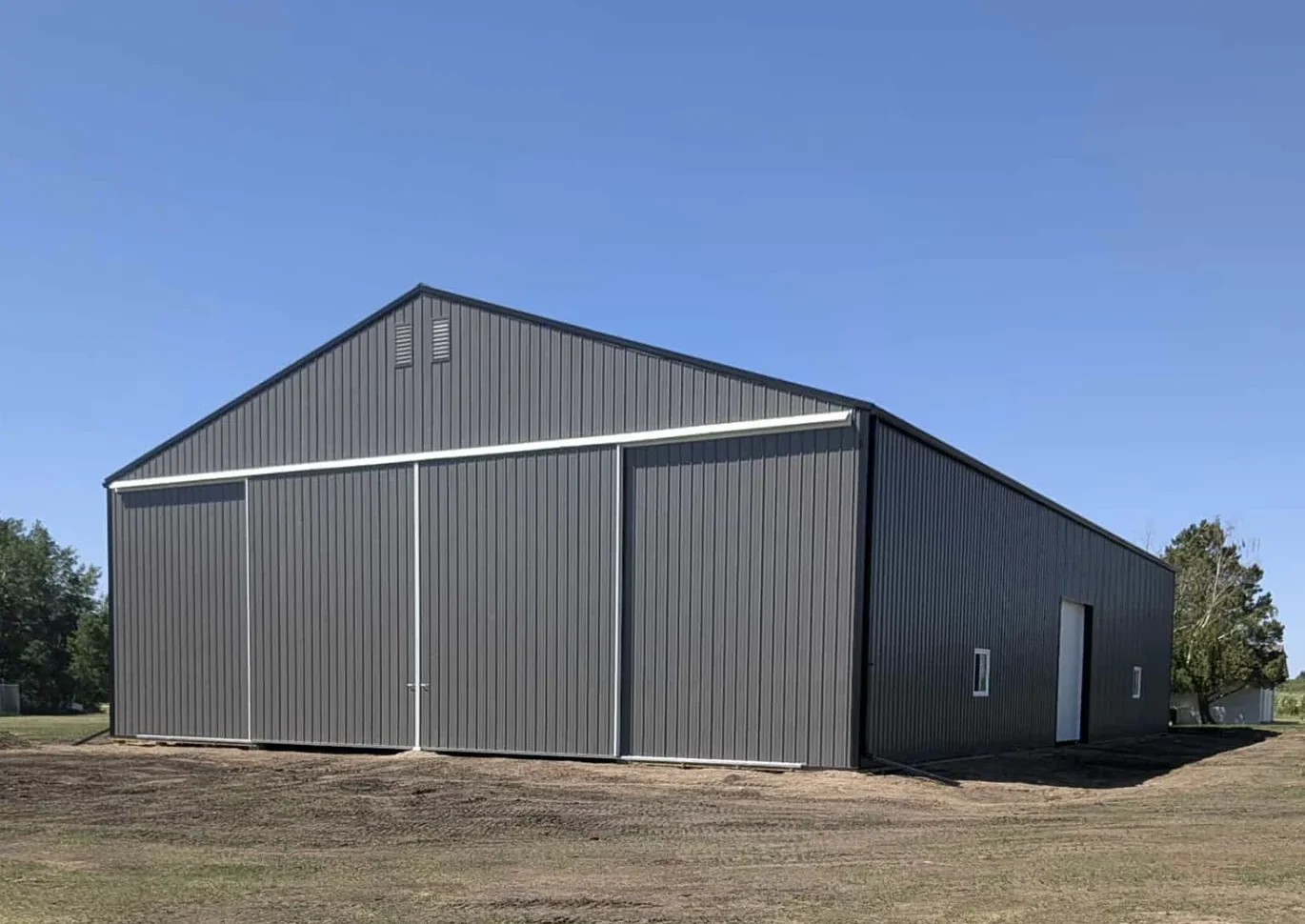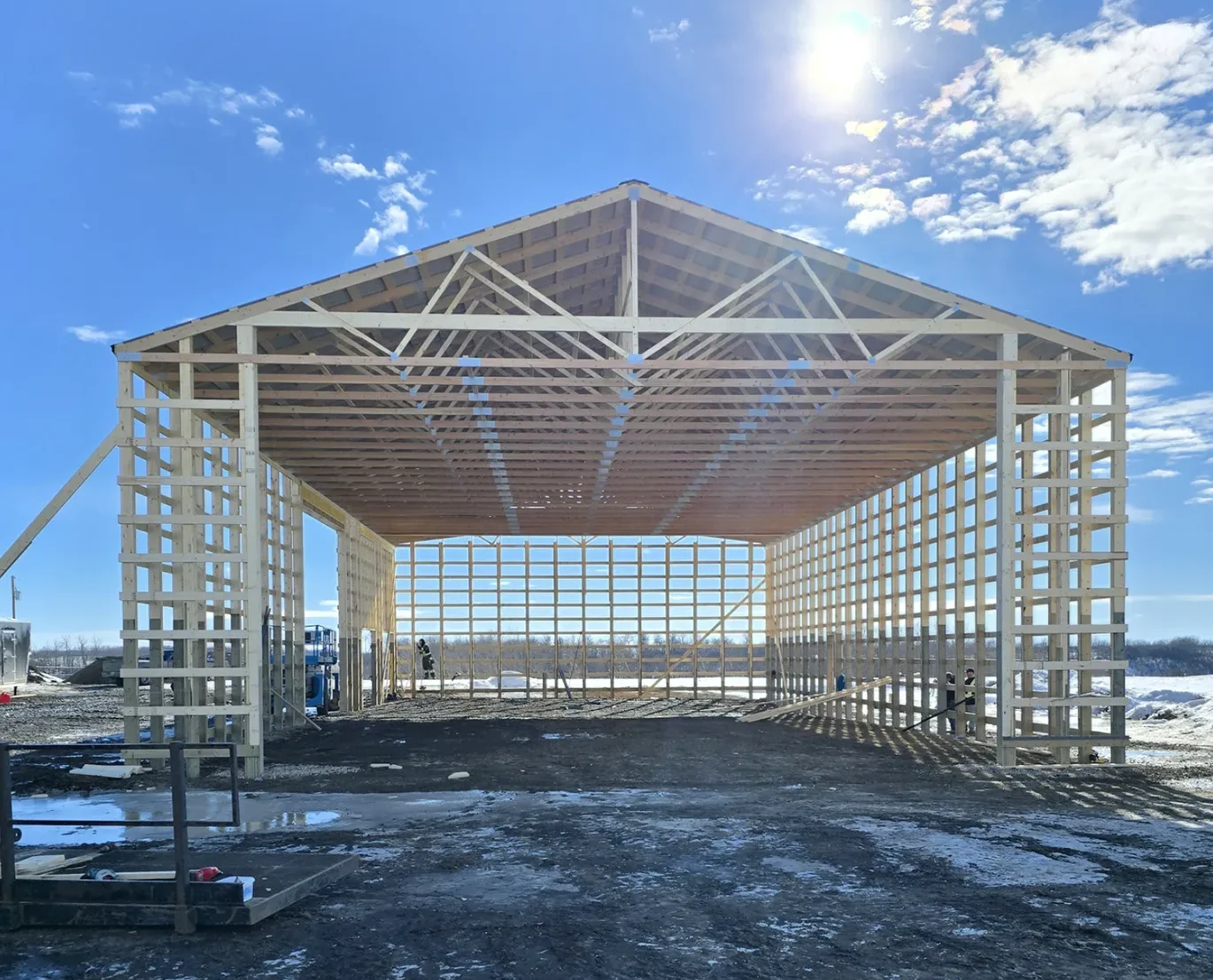
If you're looking for more space to park vehicles, store equipment, or finally have a proper shop to work in, a post frame garage is worth considering. It's one of the most common projects we build for acreage owners across Western Canada, and there's a good reason for that - you get a lot of building for your money.
But before you start picking out colours, there are some things worth thinking through. A garage that works perfectly for your neighbour might not work for you. Here's what you need to know before you build.
Post frame construction uses large posts as the main structural support instead of a continuous foundation and load-bearing walls. Our complete post frame construction guide breaks down everything you need to know in detail. For garages, this gives you a few advantages
Clear span space. No posts or walls in the middle of your garage means you can park equipment, turn around vehicles, and move things around without obstacles.
Lower cost. Less concrete, less lumber, faster build time. For a garage of any decent size, post frame typically costs less than stick-built.
Speed. A well-organized crew can get a post frame garage up and enclosed quickly, which matters if you're trying to beat winter.
Easy to go big. Want a 40x60 shop instead of a 24x24 garage? Post frame handles larger buildings easily.
This is the question most people underestimate. My advice: go bigger than you think you need.
A two-car garage sounds reasonable until you realize your truck barely fits and there's no room for a workbench. A 24x24 seems decent until you try to open your door without hitting the wall.
Here are some rough guidelines:
For vehicles only: Allow at least 12 feet of width per vehicle, plus extra if you have trucks or plan to open doors without dinging them. A 24x30 fits two vehicles with a bit of breathing room.
For vehicles plus storage: Bump up to 30x40 or 30x50. This gives you space along the walls for shelving, a workbench, and seasonal stuff.
For a proper shop: If you want to actually work on things - woodworking, welding, equipment repair - think 40x60 or larger. You need room for the work, plus room to store materials and move around.
Also think about ceiling height. Standard is around 10 feet to the bottom of the truss, but if you want a hoist or plan to store anything tall, go higher. It's much cheaper to add height during construction than to wish you had it later.
Not sure what size is right for you? We build custom garages and shops as part of our acreage post frame building services and can help you figure out the best layout for your property.
This depends on how you plan to use the space.
Uninsulated (cold storage): Fine for parking vehicles and storing stuff that doesn't mind the cold. Cheaper to build. You'll still want ventilation to manage condensation.
Insulated and heated: If you want to work in the garage year-round, you need insulation, a vapour barrier, and a heat source. In Alberta, Saskatchewan, and BC winters, an unheated shop is miserable from November to March.
If you're unsure, at least rough in for insulation - proper wall girts and vapour barrier - so you can finish it later without tearing things apart.
Most people want concrete for a garage, and for good reason. It's easier to keep clean, you can roll tool boxes around, and it looks more finished.
But concrete adds cost, and you need to think about timing. Some people pour the slab first and build on top of it. Others build the shell first and pour inside later. Both approaches work, but they affect scheduling and cost differently.
If budget is tight, you can start with gravel and add concrete later. Just make sure the building is designed with that in mind.
For heated garages, you might also consider in-floor heat. It's a nice upgrade, but it needs to be planned from the start.
Doors are where a lot of people make mistakes. Think carefully about what you need to get in and out of the building.
Overhead doors: The standard choice for vehicle access. Size them for your largest vehicle plus a bit of clearance. If you have a truck with mirrors, measure with the mirrors out. If you might get a bigger truck someday, plan for that now.
Common sizes are 10x10 or 12x10 for single vehicles, 16x8 or 16x10 for two vehicles side by side. For equipment or RVs, you might need 14 feet tall or more.
Bi-fold doors: Great for really wide openings where you need to get large equipment in and out. They fold up rather than rolling overhead, so you don't lose ceiling space.
Walk-in doors: Don't forget at least one. You don't want to open a big overhead door every time you need to grab something.
Windows: Optional, but natural light is nice if you're working in there. Even a few small windows make a difference.
Plan your electrical before you build, not after. Running wire is much easier when the walls are open.
Think about:
Outlets: More than you think. Along the walls, near the workbench, by the doors. 120V for general use, 240V if you're running a welder, compressor, or heater.
Lighting: LED shop lights are cheap and bright. Plan for enough that you can actually see what you're doing. Nobody ever complained about too much light in a shop.
Panel size: If you're running heat, a welder, and a compressor, make sure your panel can handle it.
If you're on an acreage, you might also need to think about getting power to the building in the first place. That can add cost depending on distance from your main panel.
Even unheated garages need ventilation. Without it, you get condensation on the metal panels, which leads to dripping and eventually rust.
For cold storage, gable vents and a vented ridge cap are usually enough to keep air moving.
For heated shops, you need to think about fresh air intake and exhaust, especially if you're doing anything that creates fumes (painting, welding, running engines). A good HVAC setup makes the space comfortable and safe.
The quality of materials matters. Laminated columns, GRK structural screws, 28-gauge metal panels - they're what separates a garage that holds up from one that doesn't. You'll notice the difference in how the doors track, how tight the building stays, and how little maintenance you deal with over the years.
Want to know what quality materials look like? See the premium building post frame materials we use on every MaxBuilt project.
In most parts of Alberta, Saskatchewan, and BC, you need a permit for a garage over a certain size. The threshold varies by municipality - sometimes it's 100 square metres, sometimes it's different.
Some areas also require engineered drawings, especially for larger buildings. Your builder should know what's required in your area and handle the permit process.
Don't skip the permit. It protects you if you ever sell the property, and it ensures the building is inspected and built to code.
If you haven't built a post frame structure before, it helps to know what to expect. A good builder will walk you through the timeline, lock in materials early, and keep you updated as the project moves along. There shouldn't be surprises. See how our post frame construction process works at MaxBuilt from start to finish.
If you're talking to post frame builders, here are some things worth asking:
A good builder will answer these questions clearly and won't get defensive about details.
A post frame garage is a solid investment for any acreage property. You get durable, functional space that will serve you for decades - if you plan it right from the start.
If you're in Alberta, Saskatchewan, or BC and thinking about a post frame garage, we'd be happy to talk through your project. At MaxBuilt, we provide expert post frame garage construction and can help you get the most space, function, and value for your budget.
Get a free quote to start your custom post frame garage project.
© Copyright 2026 | MaxBuilt | All Rights Reserved